
Weapons
California has the strictest gun and other weapon laws in the country. Gun possession is criminalized based on the type of gun, how it is carried or stored, and who is possessing it.
Based on the dozens of different laws criminalizing guns, one act of possessing a gun usually violates multiple statutes.
For example, if a minor on probation for a felony has a concealed, loaded, 3-D printed firearm at school, this single act could be charged as at least 7 different felonies (PC §§ 25400(a) [concealed firearm], 25850(a) [loaded firearm], 626.9, [gun at school], 29610 [minor with gun], 29815 [gun in violation of probation], and 29820), and 24610 [undetectable or “ghost” gun].)
California criminalizes possession of many other weapons that are legal in other states such as brass knuckles, throwing stars or shurikens, and switch blades. Regardless of the weapon at issue, several defenses remain available for any type of weapon possession offense.
Weapon Not Meeting Illegal Criteria
Each weapon possession, sale, or manufacturing statute has unique “elements” the prosecution has to prove before someone can be found guilty of the crime.
For example, carrying a concealed knife, or “dirk or dagger,” is only illegal if (1) it was concealed, meaning no substantial portion including the handle was showing, (2) you knew you were carrying it–you didn’t forget it was in your pocket, (3) it could be used readily to stab someone, and (4) you knew it could be readily used to stab someone. If the prosecution fails to prove any one of these “elements” of the offense, you are NOT GUILTY of violating the statute, Penal Code § 21310.
Reading the statute you are charged with is a good place to start to see what elements the prosecution has to prove before you can be found guilty of a particular weapon law. For a detailed and official list and explanation of what the DA most prove, look up the jury instruction for your offense. These are the instructions the judge will read to the jury if you take your case to trial. You can find a PDF of the full set of California criminal jury instructions here.
No Possession
For most offenses, possession is more complicated than whether you had a weapon in your pocket or backpack. Possession can be actual–on your person–or constructive, meaning you are not carrying it, but it is in your “control.” If police are pulling you over and you ask your girlfriend to stash your gun in her purse, this will not necessarily clear you of possessing the weapon if police find it, because it may still be in your control.
It is important to read the jury instruction for your particular offense to see what exactly the prosecution has to prove. For most weapon possession offenses, proving the weapon was in your control will suffice, such as if the police find the weapon in your room during a search, even if you are not there. For some offenses, though, the DA has to prove the weapon was readily accessible to you.

Do not settle for an attorney looking for the easiest way to settle your case.
PROUDLY SERVING
Ventura County
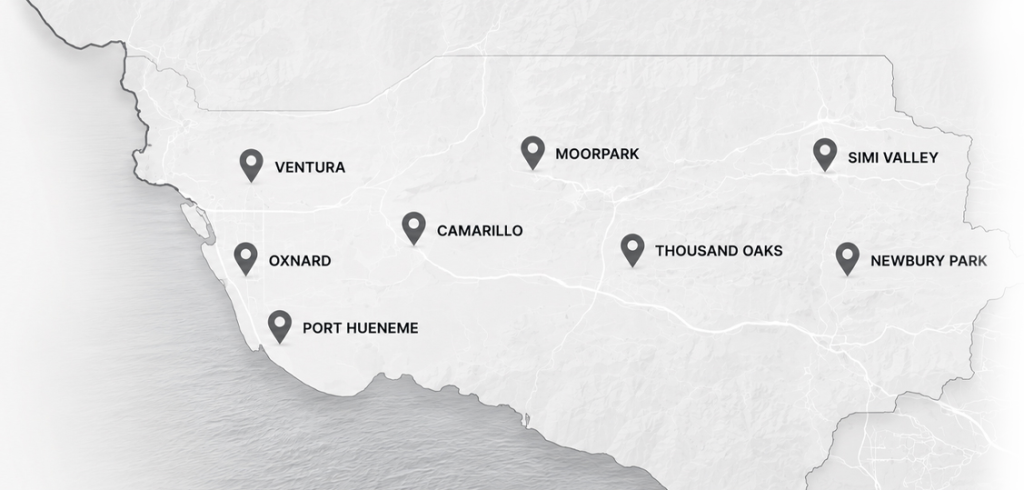
We proudly represent clients in every city and community across Ventura County.
About Weapons Charges in Ventura County
California weapons law is aggressive and highly technical. Common charges include Penal Code Section 25400 (carrying a concealed firearm), Section 25850 (carrying a loaded firearm in public), Section 29800 (felon or specified misdemeanant in possession of a firearm), Section 30605 (assault weapons), and Section 16590 which incorporates the generally prohibited weapons list (billy clubs, brass knuckles, certain knives, nunchucks, etc.). Depending on aggravators, a felon-in-possession case (Section 29800) carries 16 months, 2 years, or 3 years in state prison. Sentencing enhancements under PC 12022.5 and 12022.53 (the “10-20-life” law) can add decades to underlying felonies where a firearm is used.
Ventura County has a mix of urban and rural jurisdictions; charging patterns vary by city. Common defenses include challenging the initial stop or search (Fourth Amendment), disputing constructive versus actual possession (particularly in shared vehicles or homes), proving lawful transport under Penal Code 25610, and negotiating wobbler charges (like Section 25400) down to misdemeanors where permissible. Prior-conviction status is critical — a case that would be a misdemeanor for an ordinary citizen becomes a felony for someone with a qualifying prior.
Hali Ford defends possession, transport, and use cases, including cases involving CCW disputes, self-defense claims, and post-conviction firearm restoration issues. Explore criminal defense, related charges like strike offenses, or gang enhancements. Statutory text: Penal Code Section 25400 on Justia.
Ventura County weapons defense — 805-853-FREE or contact us.