

Divorce & Separation
It was never the plan, but now may be the only path forward to peace and freedom. Divorce or legal separation can provide you with the space you need to grow, heal, and reclaim your life. Divorce can be relatively simple or it can drag on for years.
What to Expect When You’re Getting a Divorce
The complexity of your divorce depends primarily on whether you and your soon-to-be-ex spouse agree on things, but your divorce will also be simpler if you have minimal assets and no children.
Below is a birds-eye view of what you can expect in the process given your personal circumstances.
Types of Divorce
Summary Dissolution
Summary Dissolution is the fastest and least expensive way to end a marriage in California, but only a limited number of couples qualify.
Generally, you may qualify if:
- You have been married for less than five years.
- You do not have children together.
- You do not own any real estate.
- You have less than approximately $7,000 in joint debt (excluding vehicle loans).
- You have limited jointly owned and separately owned assets, excluding vehicles.
If you meet these requirements, you may be able to complete your divorce without hiring an attorney, using California's streamlined Summary Dissolution process.
Uncontested Divorce
If you do not qualify for Summary Dissolution, you may still be able to finalize your divorce in approximately six months with relatively low legal costs if you and your spouse agree on all major issues.
The process generally begins by filing a Petition for Dissolution of Marriage. Both spouses must then exchange financial disclosures regarding income, expenses, assets, and debts.
If you reach an agreement on issues such as:
- Child custody and parenting time
- Child support
- Spousal support
- Division of property
- Allocation of debts
You can submit a written settlement agreement to the court and obtain a final judgment without going to trial.
Although many couples complete an uncontested divorce without an attorney, it is often wise to have a family law attorney review the agreement—especially when children, retirement accounts, real estate, or substantial assets are involved.
Contested Divorce
When spouses cannot agree on one or more issues, the divorce becomes contested. Contested divorces often take longer than California's minimum six-month waiting period and usually require significantly more court involvement.
If your spouse has already hired an attorney, you should strongly consider hiring one as well. If you cannot afford legal representation but your spouse can, the court may order your spouse to contribute toward your attorney's fees under Family Code section 2030.
Contested divorce cases commonly involve disputes regarding:
- Domestic violence restraining orders
- Child custody and visitation
- Child support
- Spousal support
- Property division
- Debt allocation
Preparing for hearings and trial often requires formal discovery, including document requests, written interrogatories, depositions, subpoenas, and other methods of gathering evidence.
Many contested cases ultimately settle during negotiations, mediation, or the discovery process. Others require a judge to decide the disputed issues after trial.
While California's Self-Help Centers allow individuals to represent themselves, contested divorces can quickly become complicated. Self-representation is generally not recommended if the other spouse has retained legal counsel.
Legal Separation
Legal Separation is not a divorce, but it allows spouses to resolve nearly every issue that would normally be addressed in a divorce while remaining legally married.
Some couples choose legal separation because of religious beliefs, while others do so to preserve health insurance, military benefits, or other financial advantages.
Legal separation can also help couples who do not yet meet California's residency requirements for divorce.
Unlike divorce, legal separation does not require:
- Six months of California residency.
- Three months of residency in the county where the case is filed.
This allows couples who recently moved to California to immediately begin court proceedings. Once the residency requirements are met, the legal separation petition can be amended to request a divorce instead.
Any time that passes after your spouse responds to the legal separation petition counts toward California's mandatory six-month waiting period for divorce.
Like a divorce, a legal separation may resolve issues involving:
- Child custody and parenting time
- Child support
- Spousal support
- Division of property
- Allocation of debts
If your circumstances change in the future, you can later ask the court to convert your legal separation into a divorce.
The Divorce Process
Deal with Any Emergencies
Some divorces begin during a crisis. If your spouse is abusing you or your children, hiding or wasting marital assets, or another emergency requires immediate court intervention, you may need to seek emergency relief.
Depending on the circumstances, your attorney may recommend filing:
- An Ex Parte Request asking the judge to issue immediate emergency orders.
- A Domestic Violence Restraining Order to protect you and your children.
A restraining order may be requested without first opening a family law case. Most other emergency requests, however, require a divorce or legal separation case to already be on file.
If the matter is urgent but not an actual emergency, you may instead file a Request for Order and ask the court to shorten the hearing date so your request can be heard sooner.
File & Serve the Initial Paperwork
Petition (FL-100)
The Petition for Dissolution of Marriage identifies basic information about your marriage and tells the court what relief you are requesting, including issues such as child custody, child support, spousal support, and property division.
Although the petition can be amended later, it is generally best to carefully consider your requests before filing. California law also now allows qualifying spouses to file a joint petition for dissolution.
Summons (FL-110)
The Summons formally notifies your spouse that a divorce or legal separation case has been filed and explains how and when they must respond.
Automatic Temporary Restraining Orders (ATROs)
Once the Petition and Summons are served, California's Automatic Temporary Restraining Orders immediately become effective for both spouses.
These orders generally prohibit either spouse from:
- Removing children from California without permission.
- Applying for passports for the children without the other parent's consent.
- Making unusual or extraordinary expenditures.
- Changing insurance beneficiaries or canceling insurance coverage.
Additional Forms for Children
If you have minor children together, you must also complete Form FL-105, which provides the court with information regarding the children's residence and any other custody proceedings.
Filing Fee
Most divorce cases require payment of the filing fee, although fee waivers are available for qualifying individuals.
Initial Financial Disclosures
Within 60 days after filing, each spouse must exchange financial disclosures identifying income, expenses, assets, debts, and property. These disclosures are exchanged directly between the parties and generally are not filed with the court.
Request Temporary Orders
While your divorce is pending, you may need temporary court orders to address important issues until the case is finalized.
Temporary orders commonly address:
- Child custody and visitation.
- Child support.
- Spousal support.
- Who remains in the family home.
- Payment of household expenses.
- Any other disputed issue requiring immediate court intervention.
Most requests are filed using Form FL-300 (Request for Order). Depending on the issues involved, additional forms and financial disclosures may also be required.
If both spouses agree on temporary arrangements, the agreement may be submitted directly to the court and entered as an enforceable court order without the need for a contested hearing.
If a hearing is necessary, multiple requests may usually be combined into a single hearing to reduce filing fees and legal costs.
Obtain Final Decisions
If you and your spouse ultimately agree on every issue, the final settlement agreement may be submitted to the court for approval, allowing the judge to enter a final Judgment of Dissolution.
If disagreements remain, those issues must be resolved through negotiation, mediation, hearings, or trial.
Some issues may be bifurcated, allowing the court to decide one issue separately from the others. For example, some couples choose to legally terminate their marital status before resolving property division or support issues.
During contested litigation, attorneys commonly use formal discovery to gather evidence, including:
- Depositions
- Form Interrogatories
- Special Interrogatories
- Requests for Production of Documents
- Subpoenas Duces Tecum
Before trial, most cases require at least one settlement conference, and families with children are generally required to participate in mediation regarding custody and parenting issues.
If settlement cannot be reached, the case proceeds to trial, where each party presents witnesses, documents, and legal arguments. The judge will then decide the disputed issues and issue final orders.
After every issue has either been resolved by agreement or decided by the court, the final Judgment is submitted for the judge's signature, officially concluding your divorce.
Although the process may feel overwhelming now, it will come to an end—and you will move forward with the next chapter of your life.


Her skills in depositions, trial work, and cross-examination are outstanding and she knows exactly how to elicit the right testimony. She fought for me during an especially difficult situation, where my ex was involved with his attorney — something that complicated the dynamics significantly.
Her balanced approach between litigation and settlement is rare and invaluable. Since my case was transferred to her, not only did I feel more protected legally, but my mental health significantly improved as well.
If you are looking for someone who will truly stand by you, advocate for truth, and handle even the most complex situations with skill and compassion, I can’t recommend Hali enough.


If you are unsure whether or not you need an attorney or if you have other questions, give us a call for a free consultation.
PROUDLY SERVING
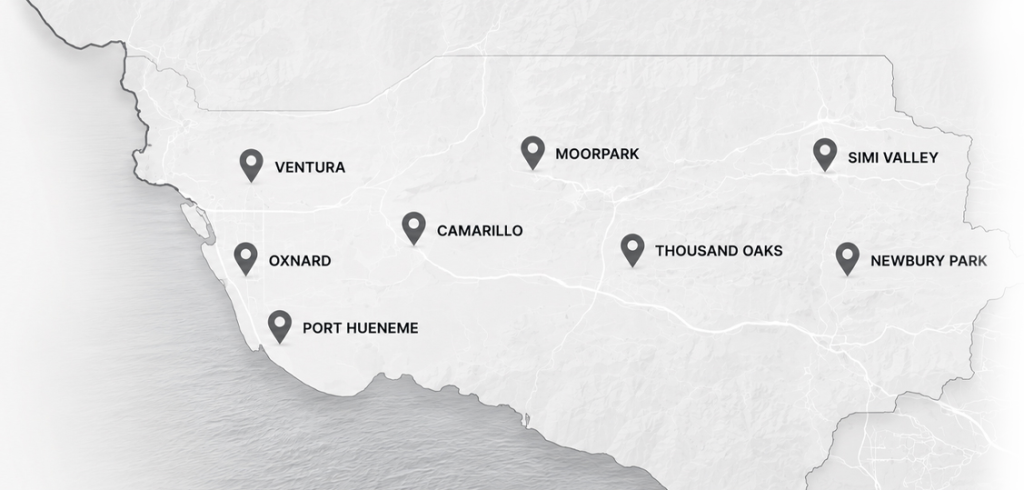
Ventura County
We proudly represent clients in every city and community across Ventura County.
About Divorce & Separation in Ventura County
California divorce is governed by the Family Code. Family Code Section 2310 establishes the grounds — irreconcilable differences (California is a no-fault state) or permanent legal incapacity. Section 2320 imposes the residency requirement: at least 6 months in California and 3 months in the county before filing. After a Petition (FL-100) is filed and served, there is a mandatory 6-month waiting period under Section 2339 before the marriage can be legally terminated. Section 2200 covers voidable marriages (annulment), and Section 2400 covers Summary Dissolution for short, low-asset marriages meeting narrow criteria.
The Ventura County Superior Court handles family matters in Ventura and Simi Valley (East County). Most cases involve companion issues: child custody, child and spousal support, and property division. Court-connected mediation is required for custody disputes (Family Code 3170). Where the parties can agree, an uncontested dissolution via written stipulation is significantly faster and cheaper than a contested trial. Legal separation (Section 2310) is an alternative that preserves marital status for religious, insurance, or immigration reasons while dividing finances.
Hali Ford represents petitioners and respondents in Ventura County dissolutions from filing through judgment, including cases involving businesses, retirement accounts, and complex custody schedules. Explore family law practice, restraining orders. For self-help resources: California Courts self-help — divorce. Statute: Family Code Section 2310 on Justia.
Free consultation — 805-853-FREE or contact us.